Biocompatible Wound Biosensing Scaffolds & Wireless Telemetry Matrix
Reference framework: Frontiers Wound Monitoring & Sensing Special Issue and ISO 10993-12 / ISO 14708-1.
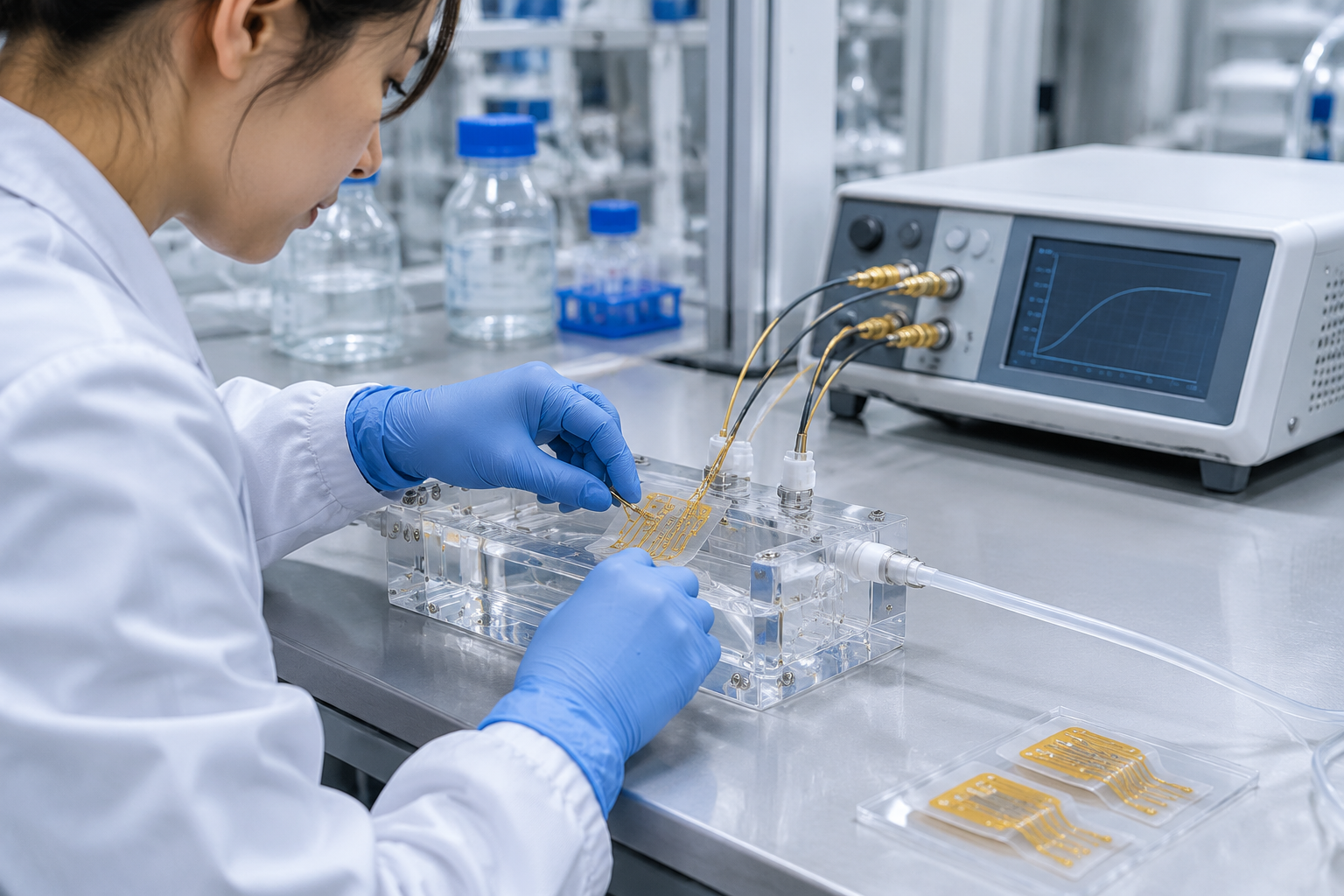
1. Sensor Encapsulation & Biocompatibility Matrix
Continuous wound-bed monitoring tracks local pH shifts (alkaline drift from pH 5.5 toward 7.4 to 8.5 signals bacterial colonization), perilesional temperature gradients (+1.5 C elevation preceding clinical erythema), transepidermal moisture, and inflammatory protease activity. Integrating electrochemical sensors directly inside healing hydrogel scaffolds avoids traumatic dressing removal, but creates a dual engineering challenge: the active sensing window must stay permeable to protons or biomarkers while hermetically sealing interconnects against salty exudate corrosion.
Standard consumer flexible printed circuits rely on bare electroless nickel immersion gold (ENIG) over copper traces with solder mask resins that leach cytotoxic photoinitiators and copper ions within 24 hours of warm saline immersion. Translational wound devices replace copper with sputtered gold or screen-printed carbon/PEDOT:PSS tracks on polyimide or thermoplastic polyurethane, passivated everywhere except the sensing pad via vapor-deposited Parylene-C and capped with anti-fouling alginate or zwitterionic hydrogel coatings.
| Biosensor Layer | Biomarker & Signal Modality | Primary Failure / Leachable Mode | Encapsulation & ISO Gate |
|---|---|---|---|
| Polyaniline / Carbon pH Electrode | Open-circuit potential (59 mV/pH unit) | Protein biofouling shifts baseline potential > 15 mV | Zwitterionic Coat 72h serum drift < 0.1 pH |
| RTD / NTC Temperature Array | Resistance delta (+/- 0.05 C resolution) | Exudate ingress shorts adjacent leads via pinhole defects | Parylene-C 5 um DC leakage < 10 nA @ 5V |
| PEDOT:PSS / Graphene Impedance | Epithelial barrier recovery (1 to 100 kHz) | Delamination or trace flake shedding into wound bed | Adhesion Peel Test Zero particle release |
| BLE / NFC Wireless Transponder | Sub-mW packet telemetry & coil harvest | Tissue dielectric detuning & battery thermal rise | Medical Silicone SAR & temp rise < 1.0 C |
2. Low-Power Wireless Telemetry & Data Integrity Constraints
Continuous wireless wound monitoring in ambulatory or spaceflight analog environments places strict limits on RF tissue absorption, packet loss across moisture-saturated dressings, and baseline calibration drift. Passive near-field communication (NFC, 13.56 MHz) eliminates implanted lithium coin cells entirely, harvesting microwatt energy only during intermittent smartphone or reader interrogation, whereas Bluetooth Low Energy (BLE, 2.4 GHz) provides automated continuous time-series logging at the cost of antenna detuning when wound exudate conductivity spikes.
To separate genuine inflammatory flares from sensor hydration artifacts, modern wireless architectures pair every active chemical sensing channel with an encapsulated inert reference channel inside the same substrate. Differential drift subtraction, combined with on-node temperature compensation for Nernstian pH slope variations, ensures downstream clinical telemetry pipelines ingest calibrated physiological vectors rather than noisy raw voltages. Review our data hygiene standards and Stage-Gate remediation checkpoints when qualifying dual-channel prototypes.
3. Wireless Encapsulation & ISO 10993-12 Leachable Architecture
4. Sensor-Encapsulation Compatibility Triage
Select your electrode and barrier stack to evaluate leachable toxicity and exudate stability risks before ISO 10993-5 cytotoxicity testing.
Exposed copper or solder-mask resins dissolve in chloride-rich wound fluid within 24 hours, releasing cytotoxic copper ions and causing false inflammatory cytokine spikes. Replace with sputtered gold or carbon traces on polyimide.
5. Protein Corona Biofouling, Impedance Drift & ISO 10993-6 Implantation Gate
Continuous wound-bed biosensors measuring pH, transepithelial electrical resistance (TEER), lactate, or pro-inflammatory cytokines face a severe analytical drift barrier within the first 6 hours of exudate contact. Serum albumin, fibrinogen, and neutrophil extracellular traps adsorb rapidly onto hydrophobic polyimide and bare gold microelectrodes, forming an insulating protein corona that increases interfacial charge-transfer resistance (Rct) by 40% to 180% in electrochemical impedance spectroscopy (EIS). Distinguishing genuine tissue-healing progression from surface fouling requires embedding a passive reference microelectrode coated identically except for the biorecognition layer, paired with two-point sterile buffer calibration prior to patch application.
Encapsulation stack selection also dictates whether metallic interconnects leak cytotoxic ions under constant electrochemical bias. Applying cyclic voltammetry or amperometric excitation (+0.4 V vs. Ag/AgCl) accelerates anodic dissolution of trace silver, copper, or non-noble solder alloys, releasing metal cations that suppress keratinocyte migration and falsify localized tissue viability metrics. Under ISO 10993-12 and ISO 10993-18 chemical characterization, every powered sensing patch should undergo stressed 72-hour exudate-simulant extraction under active electrical bias, quantified by inductively coupled plasma mass spectrometry (ICP-MS) for copper, nickel, silver, and tin leachables.
Before advancing wearable or subcutaneous biosensing scaffolds into porcine wound-healing trials or ISO 10993-6 local implantation histology, confirm that pyrogen eluates remain below 0.5 EU/mL (or 20 EU/device per USP <161>) via orthogonal recombinant Factor C testing. Integrate electrode barrier verification with the tissue-healing hydrogel phase gates, screen any conductive 2D graphene additives via the 2D nanomaterial SOP, and log final release decisions inside the Safe-by-Design Stage Gate.
During post-implantation recovery, wireless NFC or low-power Bluetooth telemetry enclosures must isolate lithium coin cells, epoxy encapsulants, and antenna coils behind vapor-impermeable medical silicone or Parylene-C barriers verified by helium leak testing and 14-day elevated-temperature (50C) saline soak impedance monitoring. Any delamination or baseline impedance jump exceeding 15% disqualifies chronic telemetry batches prior to animal ethics submission.
Historical Lineage: Sustainable Communication Networks & Sensor Data Systems (Archived Reference)
Historical paths /anna-frster and /university-of-bremen on the 2018 to 2021 ESA Topical Team portal documented wireless sensor communication and data-analysis contributions from the Sustainable Communication Networks group at Universität Bremen (archived institutional announcements remain live at uni-bremen.de/comnets and uni-bremen.de/en/tzi). This independent portal preserves those historical topic links solely as non-affiliated archival context paired with modern ISO 10993-12 biosensor safety standards.