Safe-by-Design Biomaterials & Tissue Healing Scaffold Gates
Aligned with Frontiers Bioengineering Tissue Healing Synthesis, PMC Wound Microenvironment Studies, and ISO 10993-22.
1. Three-Phase Tissue Repair & Scaffold Failure Points
Physiological cutaneous and soft-tissue repair progresses through overlapping hemostasis/inflammation, cellular proliferation, and extracellular matrix (ECM) remodeling phases. Biomaterials designed to accelerate chronic ulcer closure or regenerate tissue under altered mechanical unloading must support early neutrophil clearance while permitting timely macrophage phenotypic transition from pro-inflammatory M1 to pro-resolving M2 states.
-
PHASE 01
Days 0 to 4Hemostasis & Innate Inflammatory ClearancePlatelet degranulation releases PDGF and TGF-beta while neutrophils and CCR2+ monocytes clear debris. Scaffold pyrogen contamination (> 0.5 EU/mL) or high surface acidity locks this phase into chronic TNF-alpha and IL-1beta elevation, preventing wound-bed closure. -
PHASE 02
Days 4 to 14Proliferation, Angiogenesis & Fibroblast MigrationM2 macrophages secrete VEGF and bFGF to drive endothelial sprouting and granulation tissue deposition. Pore sizes below 30 um or toxic monomer leachables block capillary ingrowth, whereas macroporous 80 to 250 um hydrogels promote vascularized infiltration. -
PHASE 03
Day 14 OnwardECM Remodeling & Mechanical Tensile MaturationMatrix metalloproteinases (MMP-2 / MMP-9) replace compliant type III collagen with aligned type I fibrils. Scaffolds that degrade faster than native matrix deposition leave mechanical voids; non-degradable particulate debris triggers persistent giant-cell granulomas.
2. Hydrogel vs. Biomimetic Nanocomposite Scaffold Matrix
Combining soft hydrophilic hydrogels (such as GelMA, alginate, or hyaluronic acid) with electrospun polymers or 2D conductive nanomaterials improves mechanical suture retention and electrical wound stimulation, yet introduces multi-component extractables that require coordinated ISO 10993-12 polar and non-polar solvent testing.
| Scaffold Architecture | Primary Leachable / Degradation Hazard | Endotoxin & Sterility Method | Immune Compatibility Gate |
|---|---|---|---|
| Photo-Crosslinked GelMA Hydrogel | Unreacted LAP / Irgacure photoinitiator & methacrylate oligomers | 24h ISO 10993-12 extract + kinetic rFC | Dialysis Cleared Eluate viability > 85% |
| Biomimetic Collagen-Nanocarrier Matrix | Encapsulated liposome burst release or glutaraldehyde residual | Enzymatic digestion + 10x dilution MAT | M2 Transition Check Confirm IL-10 / Arg-1 ratio |
| Graphene-Reinforced Conductive Hydrogel | Detached nanosheets & 405nm optical LAL interference | Polymyxin B TNF-alpha control + ICP-MS | Particle Shedding Gate Zero free flake migration |
| Electrospun PLGA / PCL Mesh | Residual HFIP/DMF solvent & acidic lactic acid burst | Headspace GC-MS + direct-contact ASTM F756 | pH Buffer Check Local pH >= 6.8 during hydrolysis |
3. Macrophage Phenotype & ECM Remodeling Trajectory
Biocompatible scaffolds allow pro-inflammatory M1 signaling to peak within 72 hours and subside as pro-resolving M2 macrophages coordinate fibroblast collagen assembly. Continuous M1 persistence beyond Day 7 flags either unresolved endotoxin contamination or excessive leachable cytotoxicity.
4. Scaffold Leachables & Sterilization Check
Select your scaffold sterilization and extraction workflow to verify compliance prior to wound-model implantation.
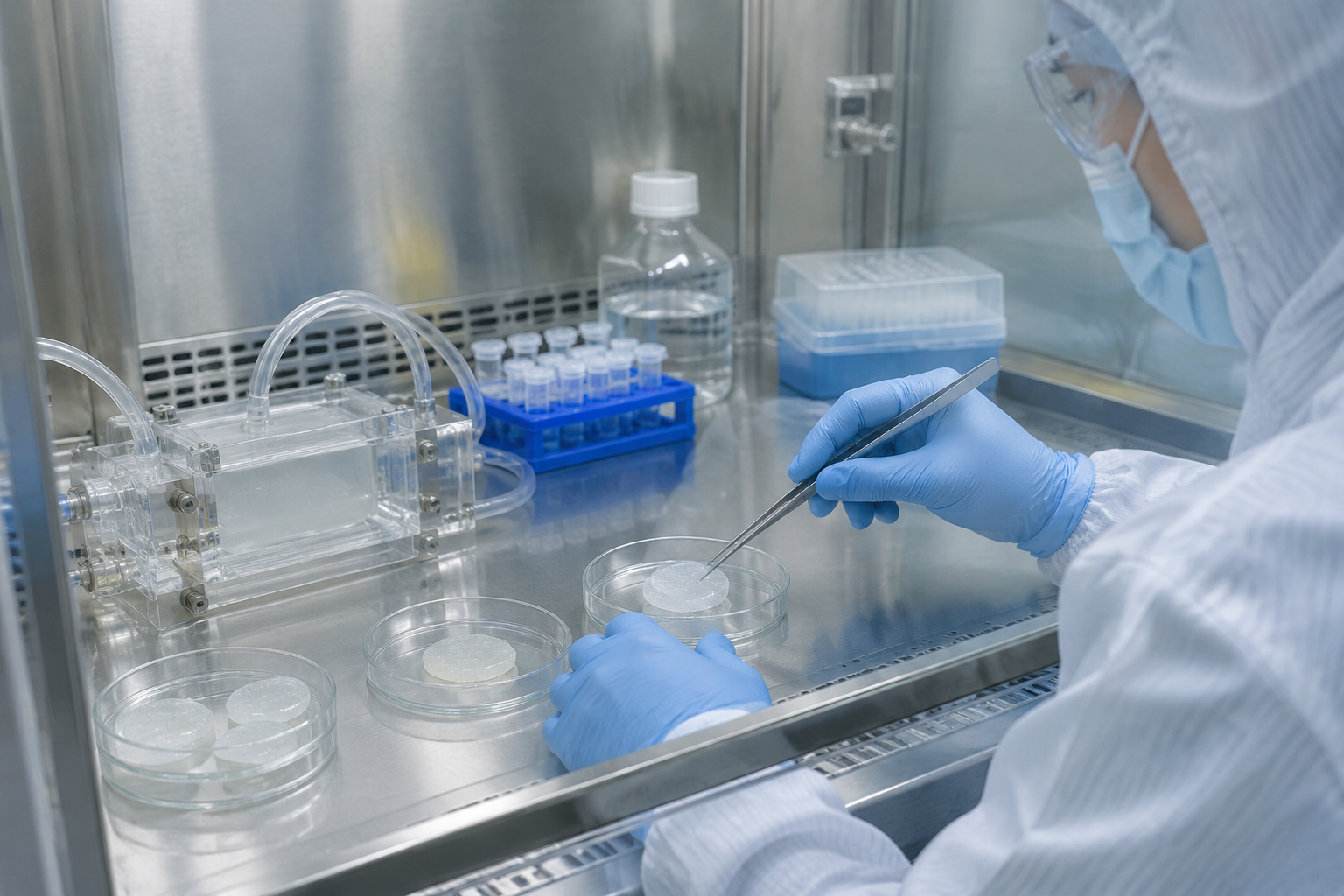
Standard 121C steam sterilization hydrolyzes collagen/GelMA networks without destroying heat-stable LPS endotoxin. Synthesize inside a Class II biosafety cabinet using depyrogenated glass and perform 48h sterile dialysis.
5. Crosslinking Chemistry, Degradation Kinetics & Macrophage Polarization
Biodegradable tissue-healing matrices fail regulatory translation most often through unmonitored photoinitiator residuals, excessive crosslink stiffness, or mismatched enzymatic degradation kinetics rather than bulk polymer composition. In photocrosslinked gelatin methacryloyl (GelMA) and hyaluronic acid-tyramine hydrogels, residual Irgacure 2959 or LAP photoinitiator fragments leach rapidly during the first 24 hours of aqueous swelling. Validating extracts under ISO 10993-12 at 37C for 72 hours (surface-area-to-volume ratio of 3 cm2/mL or 0.2 g/mL for porous sponges) captures both unreacted acrylic monomers and oligomeric degradation products before cellular seeding.
Macrophage phenotype dynamics govern whether an implanted scaffold integrates into vascularized neotissue or triggers chronic foreign-body encapsulation. Scaffolds engineered with sub-5 kPa compressive modulus, pore interconnectivity exceeding 80 um, and endotoxin burden strictly below 0.5 EU/mL preserve early physiological neutrophil recruitment followed by timely transition from pro-inflammatory M1 (iNOS+, TNF-alpha high) to pro-remodeling M2 (CD206+, Arg-1+, VEGF-secreting) macrophages between days 3 and 7. Conversely, trace pyrogens bound to cationic chitosan or collagen fibrils arrest the cascade in sustained M1 activation, elevating matrix metalloproteinase-9 (MMP-9) activity and driving premature matrix collapse.
For composite scaffolds loaded with antimicrobial ions, growth factors, or 2D conductive nanosheets, run parallel mass-loss profiling in collagenase Type II (2 U/mL) alongside dual-mode pyrogen controls via the Endotoxin & CARPA Workbench. Whenever embedded graphene or Ti3C2Tx fillers dark-quench colorimetric viability reagents (MTT or WST-1), substitute ATP luminescence or DNA-quantification (PicoGreen) assays with cell-free scaffold blank subtraction, and cross-reference extractables thresholds with our biosensing scaffold protocol and quantitative methodology.
Before advancing sterilized hydrogel dressings or vascularized grafts into in vivo excisional wound models, document mechanical retention after 7 days of simulated wound-exudate immersion at 37C under physiological shear. Swelling ratios exceeding 400% often compress microvascular channels or delaminate sutured margins, creating ischemic zones that amplify local neutrophil elastase release. Capturing storage modulus (G'), pore persistence, and endotoxin clearance inside one batch release sheet prevents costly translational failure between bench optimization and ISO 10993-6 implantation histology.
Historical Context: Tissue Healing & Monitoring Review (2018 to 2021 Archive)
The legacy page /tissue-healing-and-monitoring on the 2018 to 2021 ESA Topical Team portal presented an 11-reference scientific overview of normal three-stage tissue repair (inflammation, proliferation, and ECM remodeling) and mechanical unloading challenges in microgravity. This independent portal preserves that thematic bridge alongside current ISO 10993-12 and Safe-by-Design biomaterial validation protocols without ESA affiliation.
Historical Context: Engineered Hydrogels & Tissue Scaffolds (Archived Reference)
Historical paths /ali-khademhosseini and /ucla appeared in the 2018 to 2021 THM-ESATT academic roster covering engineered hydrogels and vascularized tissue scaffolds. Listed here solely as archived historical provenance with zero current institutional claim or endorsement.
Historical Context: Biomimetic Nanomedicine Scaffolds (Archived Reference)
Historical paths /ennio-tasciotti and /methodist appeared in the 2018 to 2021 THM-ESATT directory addressing biomimetic nanoscaffolds and immune modulation in regenerative medicine. Preserved strictly for semantic continuity and historical attribution.